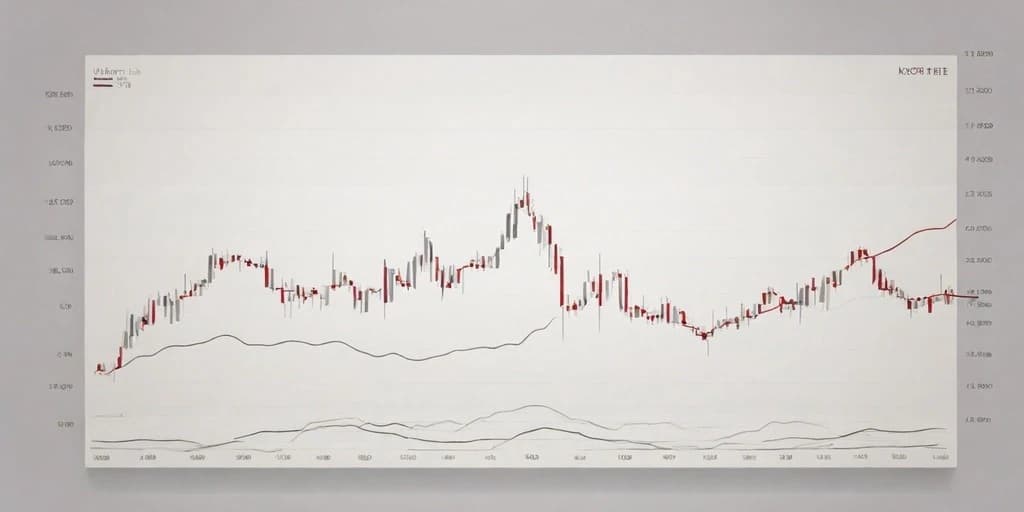
Volatility measures the speed and magnitude of price changes. Pro traders use tools like the Average True Range (ATR) and Bollinger Bands to quantify market activity and adjust risk levels accordingly.
What is Forex Volatility?
Forex volatility refers to the rate and intensity at which a currency pair’s price fluctuates over a specific period. It is not a measure of direction (trend), but rather a measure of dispersion – how aggressively the price moves within a range. High volatility suggests rapid price shifts, while low volatility indicates a period of relative calm or price consolidation.
Why Volatility Is Important for FX Traders
Understanding volatility is the difference between consistent growth and account liquidation.
- Risk Management: Volatility dictates where to place your Stop-Loss. Ignoring it leads to frequent “stop-hunting” or premature exits.
- Execution Strategy: High volatility requires breakout strategies, while low volatility often favors range-trading or waiting for accumulation.
- Position Sizing: Professional traders adjust the size of their trades based on the asset’s current volatility; you must trade smaller positions when the market is “wild” to maintain a consistent risk percentage.
Forex Volatility Indicators (Summary Table)
Trading FX Volatility: Specifications Table
Volatility in FX Market: Hard Truths 2026
Volatility is not just “market movement” – it is the fuel for institutional profit. In 2026, volatility is increasingly driven by automated HFT (High-Frequency Trading) algorithms that trigger stop-runs during low-liquidity periods. If you don’t measure volatility, you are essentially trading blindfolded.
How to Measute FX Volatility for Entry: 4 Step Guide
Step 1. Check the Economic Calendar
Filter out news-induced spikes that don’t reflect genuine technical volatility.
Step 2. Apply ATR
Look at the 14-period ATR to determine the current “range of motion.”
Step 3. Set Structural Stops
Place your stop-loss at 1.5x to 2x the current ATR to give the trade “breathing room.”
Step 4. Size Your Position
Decrease position size during high-volatility regimes to keep your risk exposure constant.
Forex Volatility Trading Scenarios: 6 Examples
Example 1. ATR Expansion (GBP/USD)
ATR rises from 15 to 30 pips.
Expert Action: Reduce position size by 50% to maintain the same monetary risk.
Example 2. Bollinger Squeeze (EUR/USD)
Bands tighten for 4 hours.
Expert Action: Prepare for a breakout; avoid trading until the directional expansion begins.
Example 3. News-Driven Spike (XAU/USD)
Price jumps $20 in 1 minute.
Expert Action: Do not trade; wait for volatility to mean-revert to avoid “slippage traps.”
Example 4. Trend Acceleration (USD/JPY)
Bands widen while ATR climbs steadily.
Expert Action: This confirms a high-conviction trend; scale into the position with trailing stops.
Example 5. Low-Vol Holiday Tradin
Markets are flat with microscopic ATR.
Expert Action: Market conditions are toxic; protect capital by staying on the sidelines.
Example 6. Mean Reversion (AUD/USD)
Price hits the lower Bollinger Band during high volatility.
Expert Action: Look for a reversal setup, as extreme deviation often attracts institutional buying interest.
Common Mistakes to Avoid
- Assuming Low Volatility = Safety: Flat markets often precede violent, unpredictable breakouts.
- Neglecting the News: Volatility readings are meaningless if you are caught holding a position through a high-impact Central Bank announcement.
- Static Stop-Losses: Using the same stop-loss distance regardless of whether the ATR is 10 pips or 50 pips.
Forex Volatility: Expert FAQ
Is higher volatility better?
Not necessarily; it increases both profit potential and risk of liquidation.
What is the best tool for beginners?
ATR is the most intuitive and easy to implement.
Does volatility change with time?
Yes, the London-New York overlap typically sees the highest daily volatility.
Can I trade volatility alone?
Yes, via “Breakout Strategies” or “Volatility Contraction” (VCP) patterns.
Why do bands squeeze?
They signal a transition from a trending state to a ranging state (and vice versa).
How do I adjust for XAU/USD?
Because Gold moves faster than Forex, double your ATR buffer.
Glossary
- ATR: Average True Range.
- Mean Reversion: The tendency of price to return to its average after an extreme move.
- Slippage: The difference between the expected price and the executed price during high volatility.
Stop guessing and start measuring. Optimize your market entries and risk management with FX broker Headway.