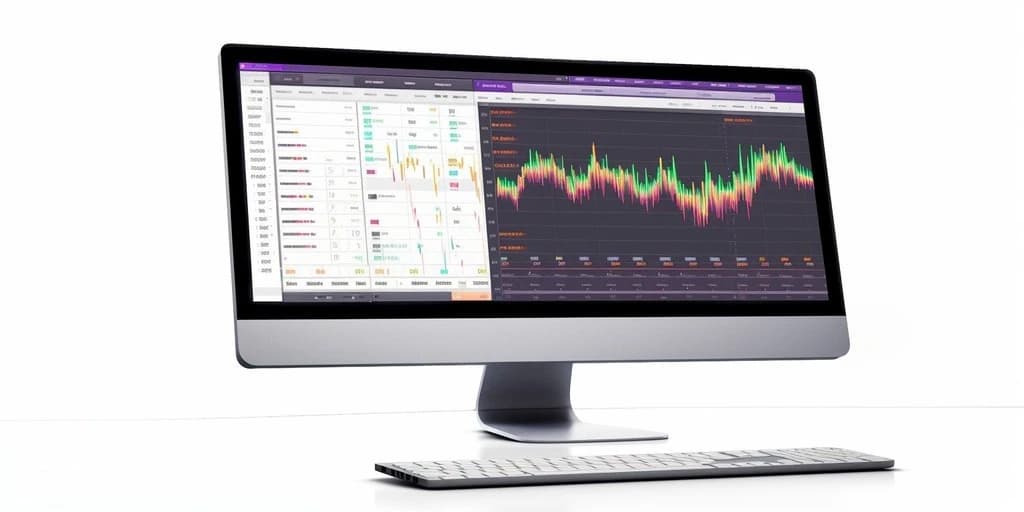
A Currency Strength Meter (CSM) is a powerful tool for trend confirmation, identifying which currencies are outperforming others. Use it to pair the strongest currency with the weakest for higher-probability trades.
What is a Currency Strength Meter (CSM)?
A Currency Strength Meter is a technical tool that calculates the relative performance of major currencies (USD, EUR, GBP, JPY, AUD, CAD, CHF, NZD) based on their price movements against other pairs. It provides a visual representation (usually a scale from 1 to 10 or a heatmap) that shows, at a glance, which currency is currently experiencing the most momentum.
How to Use the CSM Effectively: 4 Step Instruction
Step 1. Find Divergence
Look for a currency that is extremely strong (8-9/10) and one that is extremely weak (1-2/10).
Step 2. Pairing
Create a trade pair using the strongest and weakest currencies. For example, if EUR is at 9 and JPY is at 2, a “Long EUR/JPY” trade has a higher statistical probability of success based on momentum.
Step 3. Trend Confirmation
Use the CSM as a filter. Only enter long trades if the base currency is stronger than the quote currency according to the meter.
Step 4. Avoid Choppy Markets
If two currencies are both at 5/10, the pair is likely consolidating. Avoid trading these pairs until a clear divergence appears.
Pros and Cons of Using a Currency Strength Meter
Every analytical tool has its limitations. Relying exclusively on one metric can lead to tunnel vision. Here is how to evaluate the CSM:
Pros (The Advantages)
- Instant Market Clarity: Identify which pairs to focus on in seconds, saving time during high-volatility sessions.
- Trend Alignment: Acts as a powerful filter, helping you ensure that you are trading in the direction of the dominant market momentum.
- Divergence Spotting: Easily identify when a currency is becoming “over-extended” against the rest of the market, signaling potential reversals.
- Objective Decision Making: Reduces “analysis paralysis” by providing a clear, numerical ranking of currency strength.
Cons (The Pitfalls)
- The Lagging Factor: CSMs are often based on past price action. They show where the momentum is, not necessarily where it will be.
- High-Impact News Sensitivity: During major economic events (e.g., NFP, CPI), the CSM can fluctuate wildly, leading to “whipsaw” signals.
- Lacks Context: A meter shows relative strength, but does not account for technical patterns, key support/resistance levels, or fundamental news that could invalidate the momentum.
- Timeframe Discrepancies: A currency might look strong on the M15 chart but be fundamentally weak on the Daily chart. If you don’t align the meter’s timeframe with your strategy, you may end up trading against the broader trend.
CSM Trading Strategy: The Strength Gap Trade
- Identify the Gap: Wait for a spread of at least 4-5 points on the meter (e.g., USD = 8, CHF = 3).
- Technical Check: Open your chart and confirm a trend. Never trade against the meter solely on price action.
- Execution: Enter in the direction of the strength gap.
- Management: Use a Stop-Loss behind the recent swing high/low.
Mistakes to Avoid When Using Currency Strength Meter
Using it as a Sole Signal
CSM is a confirmation tool, not a standalone trading signal.
Ignoring High-Impact News
Central bank interest rate changes will instantly invalidate any strength meter reading.
Over-trading
Trading every signal the meter produces regardless of the market session or liquidity.
FAQ: Currency Strength Meter (CSM) in Trading
1. Does the CSM work on all timeframes?
It is most effective on H4 and Daily timeframes to capture significant directional trends.
2. Why does the meter change so fast?
Because Forex is dynamic. A single news release can shift the strength of a currency in minutes.
3. Is it better than RSI or MACD? It is different.
CSM measures relative strength between currencies, while RSI measures momentum of a specific pair.
4. Where can I find a reliable meter?
Use professional-grade trading terminals. Ensure your tool uses real-time data from liquid providers.
5. How do I trade with Headway?
At Headway Forex broker, you can apply this momentum-based analysis to our deep liquidity pool, ensuring your entries align with real market strength.
6. Can I use CSM for scalping?
Yes, but you need a sub-minute strength meter, which is susceptible to significant “noise.”
Glossary
- Momentum: The speed and force of price movement.
- Base Currency: The first currency listed in a pair (e.g., EUR in EUR/USD).
- Quote Currency: The second currency listed in a pair (e.g., USD in EUR/USD).
- Correlation: The relationship between the price movements of two assets.
Ready to master market momentum? Start trading with professional-grade execution at Headway. Open account for trading today!