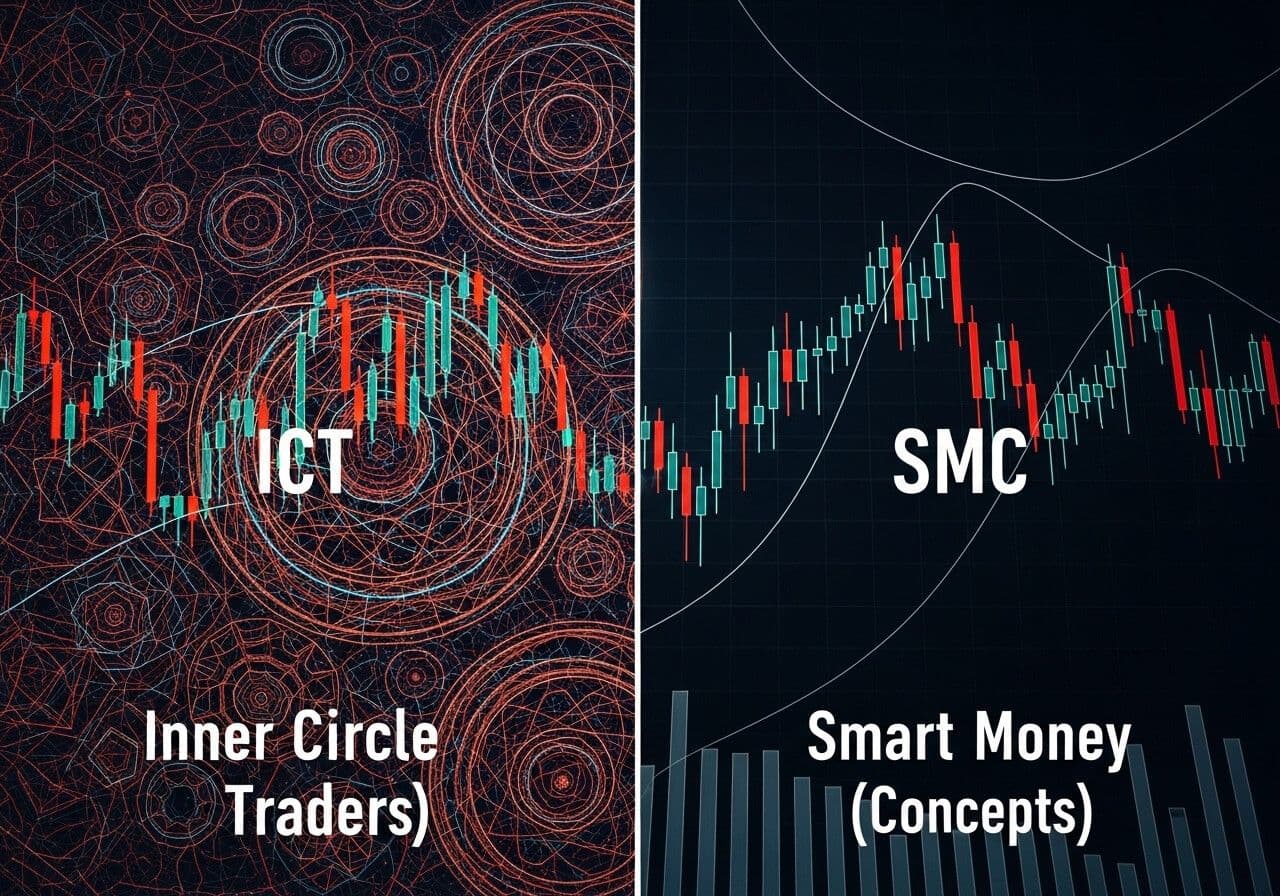
Understanding how large financial institutions and professional traders operate is key to navigating the complex world of forex trading. Two popular, yet often conflated, methodologies aimed at achieving this are Inner Circle Trader (ICT) and Smart Money Concepts (SMC).
Introduction to ICT and SMC in Forex Trading
Both ICT and SMC provide frameworks for analyzing market movements based on the perceived actions of ‘smart money’ – the whales of the market. They offer unique perspectives on identifying opportunities and managing risk.
Overview of ICT (Inner Circle Trader) Methodology
ICT, developed by Michael Huddleston, is a comprehensive educational framework focusing on identifying key market turning points and taking high-probability trades based on time-specific setups and institutional order flow. It emphasizes understanding market structure, liquidity grabs, and specific time windows where significant moves are likely.
Overview of SMC (Smart Money Concepts) Methodology
SMC is a broader term encompassing various concepts and techniques aimed at trading in alignment with institutional activity. It focuses on anticipating the moves of smart money by analyzing market structure, identifying areas of potential manipulation, and trading from supply and demand zones where large orders are likely to reside.
Similarities and Differences: A Preliminary Look
Both approaches share a common goal: to understand and capitalize on the movements of smart money in the market. However, they differ in their focus, the specific technical tools they prioritize, and the overall framework they provide.
ICT is often seen as a more rigid, time-dependent system with precise rules for entry and exit. SMC is generally considered more adaptable, offering a set of tools and principles that can be applied with greater flexibility to various trading styles.
Key Concepts and Principles
Delving deeper, we can identify core concepts that define each methodology.
ICT: Order Blocks, Fair Value Gaps (FVG), and Liquidity Pools
- Order Blocks: Specific price areas where significant buying or selling pressure occurred, indicating institutional interest.
- Fair Value Gaps (FVG): ‘Inefficiencies’ in the price action, represented by gaps between candlesticks, which ICT traders believe will eventually be filled as the market seeks balance.
- Liquidity Pools: Areas where stop-loss orders accumulate, making them prime targets for institutional traders seeking to fuel their own positions.
SMC: Market Structure, Break of Structure (BOS), and Change of Character (CHoCH)
- Market Structure: Identifying the overall trend and the sequence of higher highs/lows (uptrend) or lower highs/lows (downtrend).
- Break of Structure (BOS): A clear break of a previous swing high in an uptrend or swing low in a downtrend, confirming the continuation of the existing trend.
- Change of Character (CHoCH): A break of the immediate low within an uptrend or immediate high within a downtrend, potentially signaling a shift in momentum or a reversal.
SMC: Inducement, Supply and Demand Zones
- Inducement: A temporary price move designed to trap impatient traders into taking premature trades before the true market direction is revealed.
- Supply and Demand Zones: Areas on the chart where significant buying (demand) or selling (supply) occurred, leaving behind footprints of institutional activity and representing potential entry points for future trades.
Trading Strategies and Techniques
Both ICT and SMC offer specific strategies for putting these concepts into practice.
ICT Trading Strategies: Killzones and Time-Based Setups
ICT emphasizes trading during specific ‘Killzones’ – time periods during major market sessions where volatility and institutional activity are expected to be high. Setups are often based on anticipating movements around liquidity pools and filling FVGs within these designated time windows.
SMC Trading Strategies: Identifying and Trading Supply and Demand Zones
SMC strategies frequently involve identifying and trading from well-defined supply and demand zones. Traders look for price to retrace to these zones after a break of structure or change of character, indicating a potential opportunity to join the smart money move.
Risk Management in ICT and SMC
Robust risk management is paramount in both methodologies. Both emphasize placing stop-loss orders strategically, often just beyond order blocks, supply/demand zones, or liquidity pools, to limit potential losses. Position sizing based on account equity is also a key component.
Pros and Cons of ICT and SMC
Each approach has its strengths and weaknesses.
Advantages of ICT: Precision and Timing
ICT is praised for its focus on precise entry and exit points, particularly around specific times and price levels. This can lead to high risk-reward trades when executed correctly.
Disadvantages of ICT: Complexity and Subjectivity
ICT’s extensive education and concepts can be overwhelming for beginners. Identifying certain concepts like order blocks can also involve a degree of subjectivity, requiring significant screen time and practice.
Advantages of SMC: Simplicity and Adaptability
SMC is often seen as more intuitive for new traders, focusing on readily identifiable market structure and supply/demand zones. Its principles can be more easily integrated into various trading styles.
Disadvantages of SMC: Potential for False Signals
Like any trading approach, SMC is not immune to false signals. Identifying true supply and demand zones and distinguishing between genuine breaks of structure and manipulative moves requires experience.
Conclusion: Which Approach is Right for You?
The choice between ICT and SMC depends heavily on individual preferences and characteristics.
Factors to Consider: Trading Style, Risk Tolerance, and Time Commitment
- Trading Style: Are you seeking highly precise, time-specific entries (ICT) or a more flexible approach based on key price levels (SMC)?
- Risk Tolerance: ICT’s high risk-reward potential comes with the need for precise execution. SMC can offer more buffer with wider zones.
- Time Commitment: Both require dedicated learning. ICT may demand more adherence to specific trading times.
Combining Elements of ICT and SMC for a Hybrid Approach
Many successful traders find value in combining elements of both ICT and SMC. For example, one might use SMC to identify overall market structure and potential turning points, then refine entries using ICT concepts like FVGs or order blocks.
Further Learning Resources for ICT and SMC
Numerous resources are available for delving deeper into both methodologies. Dedicated courses, online communities, and educational content from creators and practitioners of ICT and SMC can provide valuable insights and practical application examples.
FAQ Section – ICT vs. SMC in Forex Trading
Q1: What is ICT in Forex trading?
A: ICT, or Inner Circle Trader, is a trading methodology developed by Michael J. Huddleston. It focuses on understanding how institutional traders and banks move the market. Key concepts include:
- Order blocks – areas where institutions placed large orders
- Fair value gaps – price imbalances left by institutional activity
- Liquidity sweeps – targeting stop-loss clusters before reversals
- Market structure – identifying highs, lows, and price delivery
- Killzones – specific high-probability trading time windows
Q2: What is SMC in Forex trading?
A: SMC, or Smart Money Concepts, is a trading approach that evolved from ICT principles. It focuses on tracking and following institutional or smart money movements in the market. Core concepts include:
- Break of structure (BOS) – confirmation of trend direction
- Change of character (CHOCH) – potential trend reversal signal
- Order blocks – key supply and demand zones
- Liquidity zones – areas where stop-losses are clustered
- Imbalances – price gaps created by strong institutional moves
Q3: Which is better for beginners – ICT or SMC?
A: For beginners, SMC is generally considered more accessible due to its simplified approach and streamlined concepts. However, both methodologies require significant study and practice. It is recommended to:
- Start with basic market structure concepts
- Learn support and resistance before diving into either method
- Practice on a demo account before applying either strategy
- Study SMC first then progress to ICT for deeper understanding
- Join trading communities focused on either methodology for guidance
Q4: Do ICT and SMC use the same concepts?
A: ICT and SMC share several overlapping concepts, but there are distinct differences:
- Shared concepts – order blocks, liquidity, market structure, and imbalances
- ICT-specific concepts – killzones, PD arrays, optimal trade entry, and dealing ranges
- SMC-specific concepts – break of structure, change of character, and premium/discount zones
- SMC is widely considered a simplified and repackaged version of ICT concepts
- ICT provides a more comprehensive and detailed framework for market analysis
Q5: Can ICT and SMC be used together?
A: Yes, many traders successfully combine elements of both ICT and SMC in their trading approach. Common combinations include:
- Using SMC market structure with ICT killzones for timing entries
- Applying ICT order blocks with SMC break of structure for confirmation
- Using SMC liquidity concepts alongside ICT fair value gaps
- Combining ICT PD arrays with SMC premium and discount zones
- The key is to develop a consistent and well-tested trading plan using selected concepts from both
Q6: What timeframes work best for ICT and SMC trading?
A: Both ICT and SMC can be applied across multiple timeframes, but certain timeframes are more commonly used:
- Higher timeframes (Daily, Weekly) – for overall market structure and bias
- Intermediate timeframes (4H, 1H) – for identifying key zones and order blocks
- Lower timeframes (15M, 5M) – for precise entry and exit points
- ICT specifically emphasizes top-down analysis starting from higher timeframes
- SMC traders commonly use a combination of 1H and 15M charts for trade execution
Q7: Are ICT and SMC suitable for all Forex pairs?
A: Both ICT and SMC can be applied to any liquid Forex pair, but they work best on:
- Major pairs – EUR/USD, GBP/USD, USD/JPY, USD/CHF
- Minor pairs – EUR/GBP, GBP/JPY, EUR/JPY
- Both methodologies rely on institutional activity, which is highest in major pairs
- Exotic pairs with lower liquidity may produce less reliable signals
- ICT specifically focuses on index futures and major Forex pairs in its core teachings
Q8: What are the main criticisms of ICT and SMC?
A: Both methodologies have received criticism from the trading community:
- ICT criticisms – overly complex, difficult to master, and highly subjective in application
- SMC criticisms – considered by some as a repackaged version of existing concepts
- General criticisms – both lack independent statistical validation of their effectiveness
- Some traders argue that results vary significantly depending on individual interpretation
- Both require a significant time investment to learn and apply consistently