
Introduction
In the dynamic world of Forex trading, mastering order types is fundamental to executing strategies effectively and managing risk. While many traders are familiar with market orders, understanding the nuances of pending orders, specifically buy stop and sell stop orders, can significantly enhance trading precision. These conditional orders allow traders to enter the market at predetermined price levels, offering a strategic advantage in various market conditions.
This guide will demystify buy stop and sell stop orders, clarifying their distinct mechanics, applications, and how they differ from other common order types like stop loss and limit orders. By the end of this article, you will be equipped to leverage these powerful tools to capture opportunities and refine your overall trading approach.
The Foundation: Understanding Stop Orders in Forex
In the dynamic world of Forex trading, understanding the nuances of order types is paramount. Pending orders, specifically stop entry orders, are crucial tools that allow traders to execute trades under specific market conditions, rather than at the current market price. These conditional orders are distinct from immediate execution orders and serve different strategic purposes.
It’s vital to differentiate stop entry orders from other common order types:
- Stop Loss Orders: These are primarily used to limit potential losses on an existing open position. They are triggered when the market moves against your position to a predetermined level.
- Limit Orders: These are used to enter a trade at a better price than the current market price. A buy limit order is placed below the current market price, and a sell limit order is placed above it, assuming the market will move to your desired entry point and then reverse.
Stop entry orders, conversely, are designed for entering new positions when the market is expected to move beyond a certain price level, indicating a potential continuation of a trend or a breakout. This fundamental distinction is key to building a robust trading strategy.
The Role of Pending Orders in Forex Trading
Pending orders are crucial tools in a Forex trader’s arsenal, allowing for strategic entry into the market without constant monitoring. Unlike market orders, which execute immediately at the current price, pending orders are set to trigger only when specific price conditions are met. This category encompasses several types, including stop entry orders (buy stop and sell stop), stop loss orders, and limit orders.
While stop loss and limit orders are primarily used for managing existing positions (exiting trades to limit losses or secure profits), stop entry orders are designed to initiate new trades. They are placed at a price level beyond the current market price, anticipating a directional move that will confirm a trading opportunity. Understanding this distinction is fundamental to leveraging pending orders effectively for both entry and risk management.
Differentiating Stop Entry Orders from Stop Loss and Limit Orders
While stop entry orders are designed to initiate new trades, it’s crucial to distinguish them from other common order types like stop loss and limit orders. A stop loss order is primarily a risk management tool used to automatically close an existing open position at a predetermined price to limit potential losses. Conversely, a limit order is used to enter a trade at a specific price or better, typically when you believe the market will move against your desired entry price before reaching it.
For instance, a buy limit order is placed below the current market price, expecting a pullback before the price resumes its upward trend. In contrast, stop entry orders (buy stop and sell stop) are designed to enter a trade after a certain price level is breached, signaling a potential continuation of a trend or a breakout. Understanding these distinctions is fundamental to effectively leveraging different order types for both entry and risk management.
Decoding Buy Stop Orders: Mechanics and Applications
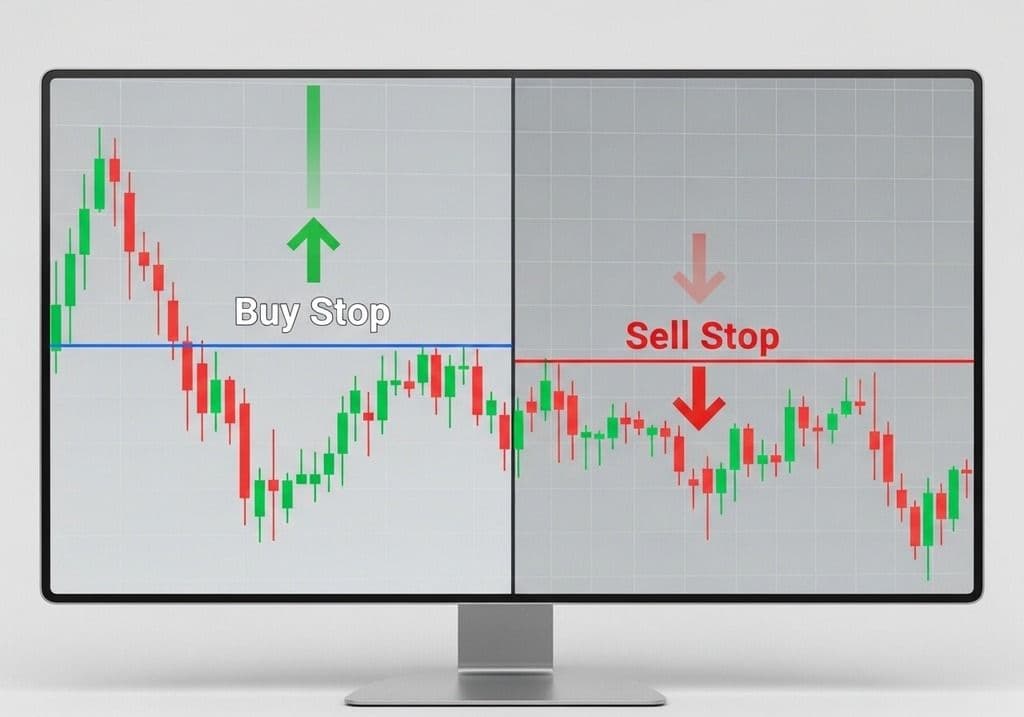
A Buy Stop Order is a type of pending order used to enter a long position in the Forex market. Unlike a market order that executes immediately at the current price, a buy stop order is placed above the current market price. It is designed to trigger and become a market buy order only when the price of the currency pair rises to or surpasses the specified buy stop level. This order type is particularly useful for traders looking to capitalize on upward price momentum, such as during a confirmed breakout above a resistance level or in anticipation of a trend continuation.
Key characteristics of a Buy Stop Order:
- Entry Level: Set above the current market price.
- Trigger Condition: The order activates when the market price reaches or exceeds the set buy stop price.
- Purpose: To enter a long (buy) position.
- Strategic Application: Ideal for capturing breakouts, trend continuations, or entering a trade once a certain price threshold indicating bullish sentiment is breached.
What is a Buy Stop Order? Definition, Triggers, and Purpose
A Buy Stop Order is a type of pending order that allows traders to enter a long position (buy) in a currency pair once the market price reaches a predetermined level above the current market price. Unlike a market order, which executes immediately at the best available price, a Buy Stop Order is placed with the expectation that the price will continue to move in an upward direction.
Definition: A Buy Stop Order is an instruction to your broker to buy a currency pair at a specific price that is higher than the current market price.
Trigger: The order is triggered and becomes a market order to buy when the market price rises to or surpasses the specified Buy Stop price.
Purpose: Its primary purpose is to capitalize on anticipated upward price movements, such as breaking through a resistance level or continuing an established uptrend. Traders use it to ensure they enter a trade at a favorable price if their breakout or continuation scenario plays out, without needing to monitor the market constantly.
Strategic Use Cases for Buy Stop Orders: Capturing Breakouts and Trend Continuation
Buy Stop orders are particularly effective in volatile markets where price breakouts are common. Traders utilize them to enter a long position after a predetermined resistance level is breached, signaling a potential continuation of an upward trend. For instance, if a currency pair is trading at 1.2000 and a significant resistance is identified at 1.2050, a trader might place a Buy Stop order at 1.2055. This ensures they enter the trade only if the price breaks through the resistance, confirming bullish momentum and reducing the risk of entering a trade that immediately reverses.
Another key application is in trend continuation strategies. In an established uptrend, prices often consolidate or pull back briefly before resuming their ascent. A Buy Stop order placed just above the recent consolidation high can automatically enter the trade as the trend reasserts itself, allowing traders to participate in the ongoing upward move without constant market monitoring.
Unraveling Sell Stop Orders: Mechanics and Applications
A Sell Stop order is a pending entry order placed below the current market price. It instructs your broker to sell a currency pair once the price drops to a specific, predetermined level. This order type is primarily used to capitalize on bearish momentum or to enter a short position when a support level is breached. By setting a Sell Stop, traders can automate their entry into a downtrend without needing to monitor the charts constantly. For example, if a pair is consolidating above a key support level at 1.1000, a trader might place a Sell Stop at 1.0995, anticipating that a break below this threshold will trigger a significant downward move.
What is a Sell Stop Order? Definition, Triggers, and Purpose
A Sell Stop order is a type of pending order used in Forex trading to initiate a short position. Unlike a market order that executes immediately at the current price, a Sell Stop order is placed below the current market price. It is triggered only when the price of the currency pair falls to or below the specified Sell Stop price. The primary purpose of a Sell Stop order is to enter a trade when you anticipate a downward price movement or a breakdown through a support level. Traders often use this order to capitalize on potential downtrends or to enter a short position once a certain price threshold is breached, confirming a bearish sentiment.
Strategic Use Cases for Sell Stop Orders: Capitalizing on Breakdowns and Downtrends
Sell Stop orders are instrumental in capitalizing on bearish market movements. Their primary strategic application lies in entering short positions when a currency pair is expected to break below a key support level. For instance, if a pair is trading at 1.1000 and shows signs of weakening, a trader might place a Sell Stop order at 1.0950. Should the price fall and breach 1.0950, the order triggers, initiating a short trade. This allows traders to participate in downtrends or profit from confirmed breakdowns without constant market monitoring. Additionally, Sell Stops can be used to enter a short position on a pullback within an established downtrend, anticipating the continuation of the downward momentum after a temporary price retracement.
Buy Stop vs. Sell Stop: Key Differences and Strategic Integration
While Sell Stop orders are designed to initiate short positions upon a price decline, Buy Stop orders serve the opposite function: they are used to enter long positions when the price is expected to rise above a certain level. A Buy Stop order is placed above the current market price, triggering a buy order only when the specified price is reached or surpassed. This contrasts with a Sell Stop order, which is placed below the current market price to trigger a sell order upon a price drop.
Key Differences Summarized:
- Buy Stop: Enters a long position when price moves up to a predetermined level above the current market price.
- Sell Stop: Enters a short position when price moves down to a predetermined level below the current market price.
Both order types are conditional entry orders, distinct from stop-loss orders which are designed to exit existing positions. Integrating both Buy Stop and Sell Stop orders into your strategy allows for proactive participation in potential breakouts and trend continuations in either direction, enhancing your ability to capitalize on market momentum.
Direct Comparison: Distinguishing Between Buy Stop and Sell Stop Orders
While both Buy Stop and Sell Stop orders are pending entry orders, their fundamental distinction lies in the direction of the anticipated price movement and the resulting market exposure. A Buy Stop order is always placed above the current market price, designed to execute a long position when the price rises to that level, typically confirming an upward breakout or trend continuation. Conversely, a Sell Stop order is positioned below the current market price, triggering a short position once the price falls to its specified level, often signaling a downward breakdown or the initiation of a downtrend. Essentially, one anticipates bullish momentum, while the other capitalizes on bearish momentum, making them inverse tools for market entry.
Integrating Both Order Types into Advanced Entry and Risk Management Strategies
Beyond their individual applications, Buy Stop and Sell Stop orders offer powerful synergy when integrated into a sophisticated trading strategy. Traders can leverage this by placing both a Buy Stop above a resistance level and a Sell Stop below a support level simultaneously. This approach aims to capture the momentum of a significant breakout in either direction. For instance, if a currency pair is consolidating, placing a Buy Stop above the consolidation range and a Sell Stop below it allows entry into the ensuing trend regardless of its direction. This dual-order placement is a form of range breakout strategy. Furthermore, these orders can be instrumental in advanced risk management. By setting protective Stop Loss orders (which are different from entry stops) at appropriate levels relative to these entry stops, traders can pre-define their maximum risk exposure before a trade even begins. This proactive risk control is essential for capital preservation in volatile markets.
Optimizing Your Use of Stop Orders: Best Practices and Common Pitfalls
While buy stop and sell stop orders offer powerful entry mechanisms, their misuse can lead to suboptimal trading outcomes. A common pitfall is placing them too close to current price levels, increasing the likelihood of premature activation by minor market noise rather than genuine breakouts. Conversely, setting them too far can result in missed opportunities if the market moves rapidly. Traders often confuse these entry orders with stop-loss orders; remember, buy stops and sell stops are designed to enter a trade, while stop losses are for exiting an existing trade to limit losses.
Best Practices for Optimization:
- Strategic Placement: Position orders just beyond identified support or resistance levels to confirm a breakout or breakdown.
- Contextual Awareness: Align order placement with your overall trading strategy and market analysis (e.g., trend continuation, reversal confirmation).
- Risk Management: Always pair stop entry orders with appropriate stop-loss orders to define your maximum risk per trade.
- Platform Proficiency: Familiarize yourself with your broker’s platform to ensure accurate order placement and modification.
Common Mistakes and Misconceptions When Placing Buy Stop and Sell Stop Orders
Traders often confuse buy stop and sell stop orders with stop-loss orders, a critical distinction. Unlike stop-loss orders designed to exit a losing trade, buy and sell stops are entry orders, placed above the current market price for buys and below for sells, to enter a new position on a breakout or trend continuation. Another common pitfall is setting these orders too close to current price levels, increasing the risk of triggering on minor fluctuations rather than significant market moves. Misunderstanding the order’s directionality – placing a buy stop below the market or a sell stop above – is also frequent, leading to unintended entries or missed opportunities.
Best Practices for Order Placement, Risk Management, and Platform Execution
To effectively leverage buy stop and sell stop orders, adhere to these best practices:
- Precise Placement: Set your entry price slightly beyond the anticipated breakout or breakdown level, avoiding areas prone to minor price fluctuations that could trigger a false entry.
- Risk Management: Always pair stop entry orders with a corresponding stop-loss order to define your maximum acceptable loss. Determine your position size based on your stop-loss distance and your overall risk tolerance.
- Platform Proficiency: Familiarize yourself with your trading platform‘s order execution interface. Understand how to correctly input the order type, entry price, stop-loss, and take-profit levels to ensure accurate and timely order placement.
- Market Context: Consider the broader market conditions. Are you anticipating a strong trend continuation or a potential reversal? This will inform whether a buy stop or sell stop is more appropriate for your strategy.
Conclusion
Mastering buy stop and sell stop orders is crucial for executing sophisticated forex trading strategies. These pending orders, distinct from stop-loss and limit orders, allow traders to enter positions once a specific price level is breached, signaling potential trend continuation or breakout. Buy stops are ideal for anticipating upward momentum, while sell stops are employed to capitalize on downward price movements.
By understanding their mechanics and strategic applications, traders can enhance their entry points and manage risk more effectively. Remember to always practice with these order types in a demo account before deploying them in live trading, ensuring a solid grasp of your platform’s execution and your chosen strategy’s nuances.


